
Intro – I’m starting a series on these related subjects – restraint, seclusion and least restrictive policies. It’s a sprawling subject so I will probably change the titles and headings over time to organise them better. But for now, here goes.
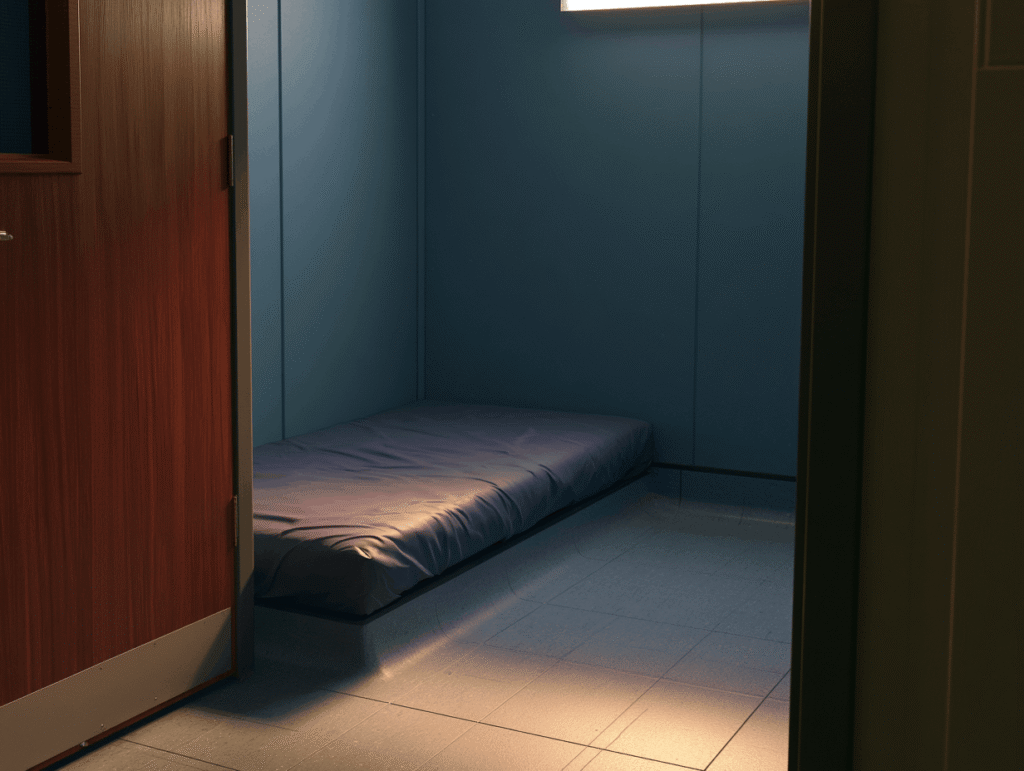
When a normal person (perhaps a mother whose ill but peaceful son or daughter is locked up on a ward with violent mad – or ASPD – patients) reads the ridiculous list of tasks we have to do after a seclusion, they may struggle to make sense of it and wonder whether our managers have gone crackers themselves. Unfortunately they haven’t. Read on. I’m going to explain the true aim of these unjust, demoralising, time-wasting and highly inconveniencing demands we must obey once we have successfully restrained, jabbed and locked up the violent patient.
The true aim of management (under orders themselves from the Department, supra-national bodies (UN, WHO) and buckets of unelected and unaccountable NGOs and activist groups) is for us to talk ourselves out of secluding that patient in the first place or the next one. (*)
They want to wear down the resolve of the coal-face nurses, punish us for denting management’s seclusion reduction stats and sow – in the minds of the gullible – the idea that tranquilising and restraining a violent patient is inherently dangerous for the patient and you mustn’t take your eyes off them for a second for fear they drop dead. It isn’t. It’s by far the safest option. Everyone, including the patient gets a break.
*) Watch professional footballers do it – unpunished – to refs. Their aim isn’t to get the current decision reversed, the one they’re squealing about, but to dissuade and intimidate him from making the next one. That’s cheating, and many managers have deliberately weaponised it against refs – Sir Alex, Arteta, Woodman, Parkinson – but I digress.
As you read, remember that all the time wasted on these punitive jobs can’t be spent on the other, non-violent patients.
The main stresses these demands put on our under-staffed, over-regulated, time and resource depleted ward are –
Time
Paperwork = documentation, checklists, forms coming out your ears, phone calls
Room entries
Extra calls on medical and qualified nurse time.
When a patient gets secluded, the ward’s workload that day instantly skyrockets. And that’s even without the ridiculous demands management make you jump through if you had to give an injection. First, you have to take one of your staff, it only has to be a qualified if you injected the patient with a sedative or two, and sit them outside the seclusion room, with eyes directly on the patient. You give them a clipboard with a form where they write an observation every 15 mins. (It could be ‘patient is asleep’, ‘patient is threatening to rape me when he gets out’ or ‘patient is asking for x, y or z’.) If you miss an entry and they catch you filling it in late, it’s a disciplinary. Next, and these requirements are timed, management will be on you if you are late, you have to call a doctor to check the patient out. It doesn’t matter whether they need it or not, its compulsory. Then you have to call the on-duty consultant to come out and review. I think the consultant has to check the patient every eight hours in the first twenty-four, then it relaxes to once a day, I think. The poor junior doctor has to come out every four hours. The qualified nurses have to review the patient – and the justification for seclusion – every two hours and record that in several places. You have to find another qualified to attend, from another ward usually, always if you’re on nights. Two qualifieds have to review, they have to physically attend and if they don’t go in to the room, you have to justify it. If you do go in the room, say the doctor presses you to (they can’t force it) or you have to take food and drink or medication or new sheets or a dozen other prescribed things, you have to rob the other wards for male staff if the patient is ready to fight. That has a knock on effect, not only on your ward, but the other nurse’s ward. That nurse has to drop their normal work because the two-hour window is imminent. People can’t go on breaks until their qualified comes back, tablets are late, notes are late, staff stay on observations for longer than the legal duration, all the regular tasks are delayed and the final result is the non-violent patients get less staff care and attention and staff go home late.
This goes on for as many days as the patient is secluded. The only relief that I know of, is when the patient is declared to be in long-term seclusion and the amount of reviews is reduced. I can’t say for sure by how much.
Continued in Seclusion Pt 2
Leave a Reply