
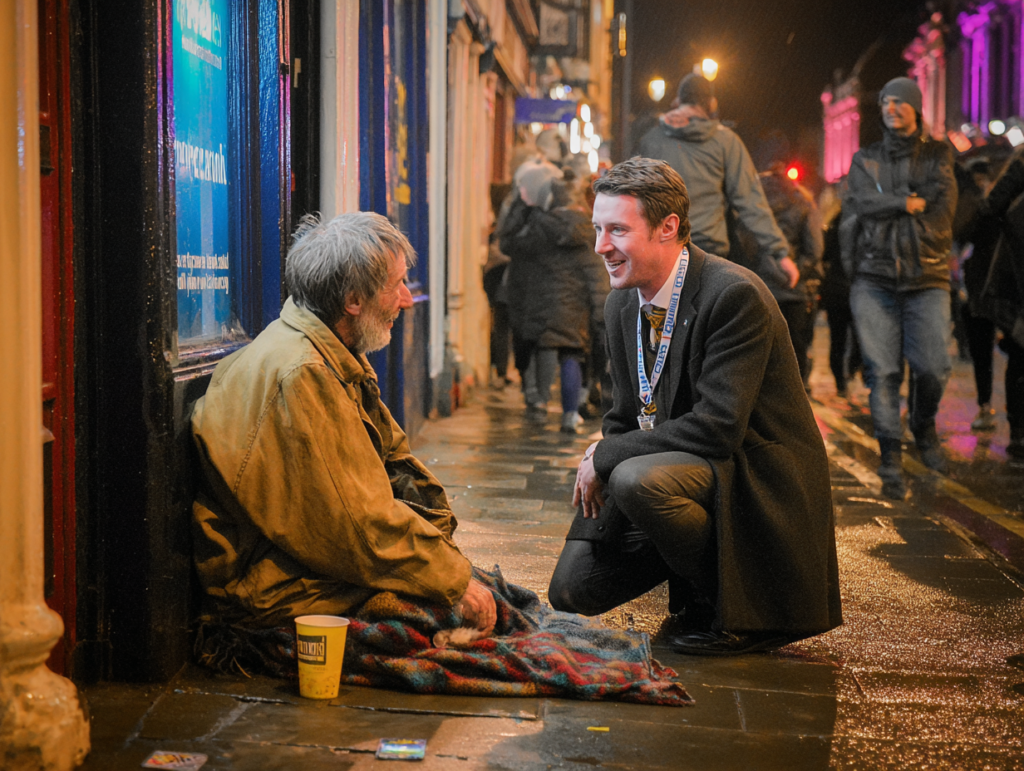
What’s the purpose of Assertive Outreach?
Put Calocane aside for now (and Clunis, Addo, Salvador and all the other worst cases) and imagine these groups instead.
AO is for patients and not-yet patients who –
a) don’t want to work with mhs, don’t want to risk being sectioned because last time it cost them weeks or months of freedom, are paranoid and delusional, are successful/partially successful criminals and don’t want mhs interfering with their activities. These are usually our frequent fliers and over the years staff will have spent a lot of time and effort working with them. They are highly skilled in hiding from us. They either ignore appointments and reviews or phone up on the day (*) to say they have the flu/gippy tummy/lost their bus fare/dog ate their homework.
*) this can be helpful, sort of, because a missed appointment is not a DNA. A DNA requires following a management ‘protocol’ otherwise known as buckets of paperwork that achieves precisely nothing on the ground.
b) are too disorganised (from drugs, alcohol, from not scoring drugs, from symptoms) to even feed themselves properly let alone engage with us.
c) a similar group is those whose other problems – debt, finding a night shelter or emergency hotel bed tonight, withdrawal, people looking for them with ill intent etc – is far more pressing than talking to nut nurses.
d) People who don’t know they are ill or becoming ill, and think it indescribably rude of you to suggest they come with you to be assessed.
e) There’s another group. Patients who aren’t having any problems thank you, except all those problems that you bastards in mental health cause me, why can’t you leave me alone and let me drink/take drugs. I’m not hurting anybody. Polly, did you spot the glaring porkie-pie? I’m not hurting anybody. So why did the police nick you? Stealing, demanding with menaces, being an aggressive drunk etc. These patients are in the Venn diagram’s intersection, connecting street policing, AOD services and us, mental health. Usually petty crimes, nuisance, swearing and drinking in public. Drunk and disorderly, selling blow jobs for alcohol and drugs. Driving customers away from whichever shop or business they’re aggressively begging outside of. I’ve seen the massive waste of police resources dealing politely and nicely with these scrotes. Why nicely? Because a progressive politician went to a conference and now wants to impress his new international mates – tough titty for you if you don’t like a maniac bellowing outside your block of flats at 1am you bigot. In the 70s they’d have been taken into the bushes and offered some negative reinforcement.
The key takeaway is all these people/patients don’t want (in various different strengths of not wanting) to have to deal with us.
Some have dodged their injection for a week/a month/a year.
Some are clearly crackers and need hospital and medication, food and physical care right now.
Some are beyond any help. Alkies who’ve passed the point of no return. Addicts who’ve been rehabbed twenty times and fallen off every time they got out. But they ruin their neighbours’ lives. And they sort of belong to us by default because end-stage alkies are suicidal (our job), have well-established co-morbid and/or alcohol induced psych disorders, depression, anxiety, confusion, psychosis (obviously our job) not to mention the organic disorders like Korsakoff’s (also our job).
Some have mothers who are both terrified of and desperately afraid for them. She daren’t let him back in the family home because he’s paranoid, delusional, insightless, addicted, and desperately needs money. Last time she let him in he hit her and threatened her. (Heaps of family homicides happen this way. I can remember the faces of patients who’d killed one parent and were ready to kill the second if discharged.)
Some are being steadily milked of their benefits, mum’s money, of everything they have by non-mentally ill scrotes.
Some are practically but not legally homeless because drug dealing cuckoos befriended (or threatened) them and took over their flat.
At the moment it’s impossible to meaningfully reach these patients – while they are ‘in the community’. The ill ones get more and more ill until a crisis – e.g. arrest, suicide attempt, accidental overdose, physical health emergency – means they are brought in to a 136 compulsorily. Sometimes the pleading of relatives and friends gets through and they allow themselves to be brought in.
A CTO can work but as I’m going to show, the entire system mitigates against it because it’s coercive. There is powerful discouragement against doctors discharging patients on a CTO – which would make the whole thing easier. And a CPN can’t get a CTO if bed management haven’t FIRST secured you a bed.
What we need are a raft of compulsory measures we can take ‘in the community’, so we don’t have to take ‘no thanks’ or ‘eff off’ as the final word. We can start at the bottom with the lightest and move upward. That means most patients will respond, knowing that we’ll continue to escalate only if they force us. The bonus is that the worst patients, who will never engage or comply, are in a smaller, more manageable group. An example.
I had a community patient on a fortnightly depot. Likeable chap when well. Dangerous beyond belief (to MoPs) when bonkers. I had to find him once or twice and bring him to the GPs & pharmacy (where he had his jab) because he was too disorganised to remember. I didn’t have to force him. We had a different (light touch) form of compulsion. He was on a few tablets as well and the one he really wanted was Procyclidine. If you save up the tablets and take them all at once you can get a nice buzz on. Apparently. So he was on daily dispensing for these and the prescription lasted two weeks. If I didn’t go to the pharmacy with him and tell the pharmacist he’d had his depot, they wouldn’t dispense the Procyclidine. So he was motivated to comply and never missed his depot by more than a day or so. Apart from managers and politicians, who thinks there’s anything wrong with that?
Leave a Reply